Comprehensive Adult Hearing Assessment
Assessment Duration
60-90 minutes | Comprehensive evaluation with detailed results discussion
A comprehensive hearing assessment gives you a detailed picture of how your hearing works in different settings. A quick screening only tells you whether your hearing has changed. This full assessment looks at several parts of your hearing health. It helps show what you're experiencing, why it's happening, and what options might help.
Many adults book this assessment after conversation starts to feel like hard work — in noisy restaurants, group chats, or phone calls with unfamiliar voices. Others come after family members notice them asking for repeats or turning up the TV. Some simply book ahead. Checking your hearing matters as much as checking your vision or blood pressure.
At our Caloundra clinic, you'll work with our Qualified Audiometrist using specialised equipment. We check your hearing sensitivity, speech understanding and middle ear function. The process usually takes 60 to 90 minutes. That allows time for thorough testing, a discussion of your results, and your questions. Understanding your hearing helps you make informed decisions about your communication health.
Your Hearing Assessment: Pure Tone Audiometry & Speech Testing
1
Case History Discussion
Your appointment begins with a conversation about what you've been experiencing. We'll ask where you notice hearing challenges most, and how long you've been aware of changes. We'll also ask about any medical history that might relate to your hearing.
2
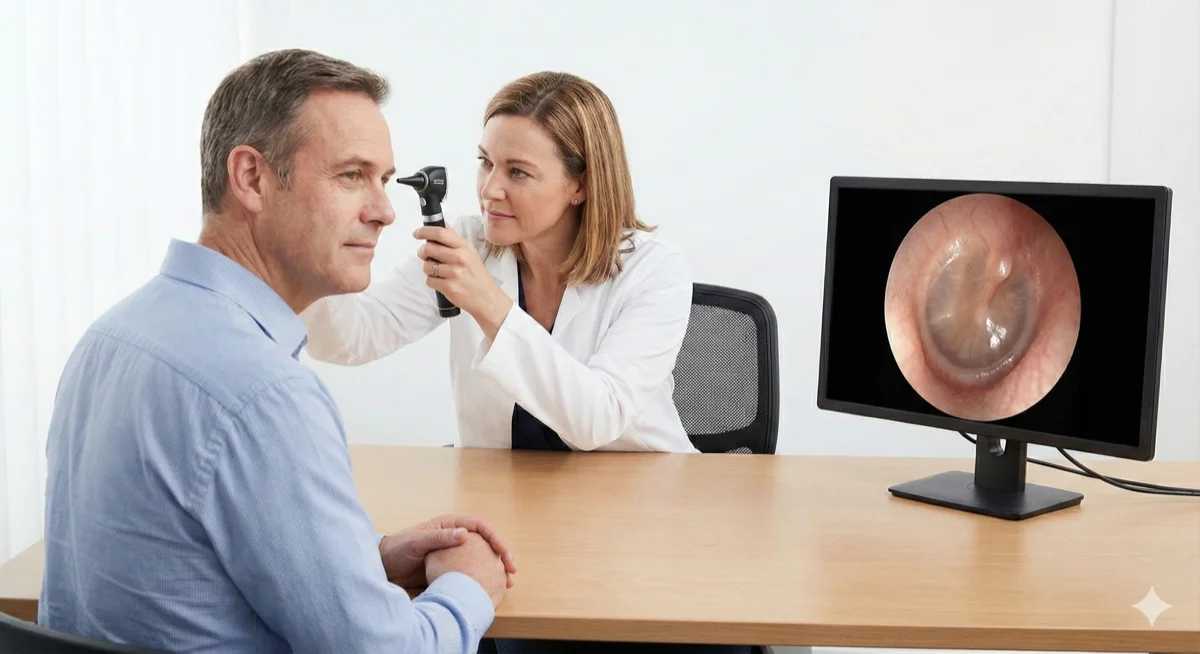
Otoscopic Examination
Visual examination of your ear canals and eardrums using an otoscope. This reveals whether ear wax buildup, fluid behind the eardrum, or structural variations might be affecting your hearing. Many modern clinics use video otoscopy, allowing you to see what the hearing care professional observes on a monitor.
3
Pure Tone Audiometry
You'll sit in a sound booth wearing headphones, and respond when you hear a tone. Tones vary in pitch and volume. This builds a detailed map of your hearing across the speech range — from low rumbles around 250 Hz to high consonant sounds around 8000 Hz.
4
Speech Testing
You'll listen to recorded words presented at different volume levels, repeating what you hear. This reveals how well you understand speech when it's loud enough, which differs from simply hearing that someone is talking. This distinction significantly influences what approaches might help most.
5
Middle Ear Testing & Results Discussion
Tympanometry examines how your eardrum moves in response to air pressure changes. Following all tests, the hearing care professional reviews your complete results, explaining patterns and discussing evidence-based solutions tailored to your hearing health needs.
Your Audiogram — What the Results Reveal
Your audiogram is the graph that shows your hearing threshold at each pitch, for both ears. We review these results with you. We explain what the patterns mean, and how your results compare with normal hearing ranges for your age. We don't just say “you have hearing loss”. We look at which sounds you hear well, which show reduced sensitivity, and what that means for everyday conversation.
The speech testing results indicate how much of your difficulty in noisy environments stems from reduced hearing sensitivity versus challenges with clarity and discrimination. Some patterns suggest hearing aids would likely help substantially, while others might indicate additional factors affecting communication that technology alone won't fully address.
We then bring all this information together into a clear picture of your hearing health. We discuss what's causing your experiences, and which evidence-based options exist. That might include a hearing aid evaluation or a medical referral. It could also include communication strategies, assistive listening devices, or a mix of approaches suited to your situation.
- Detailed Case History Review
- Otoscopic Ear Examination
- Pure Tone Audiometry Testing
- Speech Testing & Middle Ear Analysis
Who Should Book a Hearing Assessment in Caloundra
If communication is a persistent effort, it helps to understand what's happening with your hearing. Do you often ask people to repeat themselves — especially in noise, or when you can't see their face? An assessment shows whether hearing changes are part of the cause.
Do you keep nudging the TV or radio volume higher? Have family members commented on it? An assessment often reveals gradual changes you've been adapting to for months or years. The brain is good at compensating for slow hearing decline. That means you may be working much harder to follow conversations than you realise.
Some jobs involve years of noise — machinery, aviation, music or industrial work. If that's you, a baseline hearing assessment is worthwhile even if you haven't noticed problems. Your current results become a reference point for the future. Early detection of noise-related patterns also allows prevention before conversation is affected.
Preparing for Your Hearing Test
Before your assessment, think about where you struggle to hear most. Is it female or children's voices? Echoey spaces like restaurants? Hearing from another room? These patterns help the hearing care professional understand your day-to-day hearing needs, beyond what the tests alone reveal.
Your Qualified Audiometrist explains your results in plain English before you leave, so you understand what your audiogram shows. Eligible pensioners and DVA card holders may also access support through the Hearing Services Program — ask us what applies to you. We welcome patients from Caloundra, the surrounding areas and across the Sunshine Coast.
Bring a list of any medications you take regularly, as certain medications can affect hearing. Note any history of ear infections, ear surgery, noise exposure, or medical conditions affecting circulation. If you've had previous hearing tests, bringing those results allows comparison over time, revealing whether changes are stable or progressing.
After your assessment, you'll leave with a clear understanding of your hearing health and a copy of your results. If your results suggest hearing aids might help, we'll talk you through it. We'll cover which technology level suits your hearing and lifestyle, what to expect, and how the clinic's trial process works. If your results point to a medical issue, we send a report directly to your GP or ENT specialist. We work closely with medical providers to help keep your care coordinated.