


What is conductive hearing loss: causes, symptoms and treatment
In This Article
What is conductive hearing loss?
Conductive hearing loss occurs when sound cannot travel efficiently through the outer ear canal, the eardrum (tympanic membrane), or the middle ear bones (ossicles) to reach the inner ear. The inner ear itself — the cochlea, the auditory nerve, all the sensory machinery — is typically functioning normally. The problem lies upstream, in the mechanical sound delivery system.
Think of it like a partially blocked pipe. The pump at the end (the inner ear) is working fine, but the water can't get through at full pressure.
Sound waves normally follow this path: into the ear canal, vibrating the eardrum, through three tiny bones in the middle ear (the malleus, incus, and stapes — collectively the ossicular chain), then into the fluid-filled cochlea. When anything interrupts that journey — earwax, fluid, bone abnormality, a hole in the eardrum — the result is conductive hearing loss.
According to Hearing Australia, conductive hearing losses account for approximately 10% of all hearing loss cases in Australia. It can affect anyone from newborns to older adults, and severity ranges from mild (trouble catching soft sounds) to significant difficulty with everyday communication.
Common causes of conductive hearing loss
Many different conditions can disrupt the conduction pathway. Understanding the cause matters because each one requires a different approach.
Ear infections (otitis media) are among the most common causes, particularly in children. When the middle ear fills with fluid or pus during an infection, sound vibration is damped. Otitis media with effusion — also called glue ear — involves thick, sticky fluid without active infection and can persist for weeks or months.
Earwax blockage (cerumen impaction) happens when naturally occurring wax builds up to the point of fully sealing the ear canal. It's more common in people who produce more wax than average, those who use cotton swabs (which push wax deeper), and regular hearing aid users. Professional earwax removal by a qualified hearing care professional or GP resolves this quickly and safely.
Perforated eardrum (tympanic membrane perforation) reduces the eardrum's ability to vibrate. Perforations can result from severe ear infections, direct trauma, sudden pressure changes during flying or diving, or loud noise. Small tears may heal on their own within a few weeks; larger ones may require surgical repair.
Otosclerosis is an abnormal bone growth in the middle ear, typically affecting the stapes. The extra bone prevents the stapes from moving freely, blocking sound transmission. It tends to run in families, is more common in women, and usually develops in early to middle adulthood. Surgical procedures — specifically stapedectomy, where the fixed bone is replaced with a prosthetic device — can often improve hearing substantially in suitable candidates.
Eustachian tube dysfunction occurs when the tube connecting the middle ear to the back of the throat doesn't open and close properly. The result is a pressure imbalance, a plugged sensation, and temporary hearing loss. Allergies, colds, sinus infections, and frequent air travel are common triggers.
Foreign objects lodged in the ear canal block sound. Children are especially prone to inserting small objects. Professional removal is essential — attempting to extract objects yourself can push them deeper or damage the canal.
Cholesteatoma is an abnormal skin growth in the middle ear that, if left untreated, can erode bone and cause progressive damage. It typically requires surgical management.
Congenital abnormalities — including malformed or absent ear canals (aural atresia) or ossicular chain differences — are present from birth and often identified through newborn hearing screening programs.
Symptoms and warning signs
Symptoms of conductive hearing loss can appear suddenly or develop gradually, depending on the underlying cause.
The most characteristic experience is that sounds feel quieter — as though someone has turned down the volume on the world. There's often a muffled quality to sound, and a sensation of fullness or pressure in the ear, similar to what you feel during a flight.
Some people notice a paradoxical effect called paracusis: they actually hear relatively better in noisy environments, because background noise causes others to speak more loudly, which compensates for the conduction problem.
Associated symptoms — depending on cause — may include ear pain or discomfort, fluid discharge from the ear, tinnitus (ringing or buzzing sounds), dizziness, or fever if an active infection is present.
Conductive hearing loss can affect one ear (unilateral) or both (bilateral). Unilateral loss is often noticeable because you can compare the two sides — you may find yourself turning your better ear toward people when they speak.
How it's diagnosed
Diagnosis requires a professional hearing assessment. A few key tests are used:
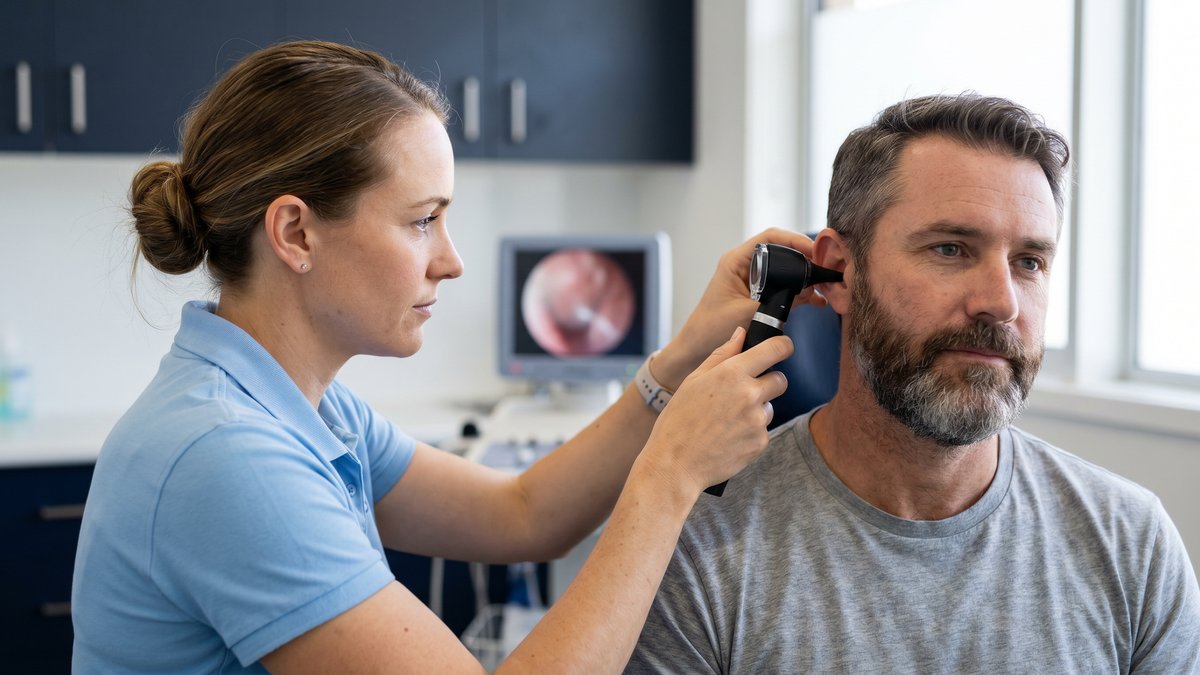
Otoscopy — a visual examination of the ear canal and eardrum — can immediately reveal obvious causes like earwax impaction, a perforated eardrum, or fluid behind the eardrum.
Pure tone audiometry measures hearing sensitivity across different frequencies via headphones (air conduction) and a bone conduction vibrator placed behind the ear. Comparing the two results is central to identifying conductive hearing loss.
Bone conduction testing bypasses the outer and middle ear entirely, sending sound vibrations directly to the inner ear through the skull. When air conduction thresholds are worse than bone conduction thresholds, it confirms a conductive component. The gap between the two results is called the air-bone gap.
Tympanometry measures how well the eardrum moves in response to air pressure changes, identifying fluid in the middle ear, Eustachian tube dysfunction, or perforations.
Speech audiometry assesses how well you understand speech at different volumes, giving a picture of functional hearing ability.
Depending on findings, an ENT specialist may recommend CT or MRI imaging to visualise middle ear structures in greater detail — particularly if bone abnormalities, cholesteatoma, or acoustic neuroma is a consideration.
Residents of the Sunshine Coast, Maroochydore, Caloundra, and surrounding communities can access comprehensive hearing assessments locally. Eligible pensioners, DVA cardholders, and certain other groups may access hearing assessments through the Hearing Services Program (HSP), subject to eligibility criteria. Contact your chosen provider to confirm details relevant to your situation.
Treatment options
The appropriate treatment depends on the underlying cause, its severity, and individual circumstances.
Medical treatment depends on the underlying cause and is directed by your GP or an ENT specialist — for example, addressing an infection, managing Eustachian tube dysfunction, or monitoring glue ear that is likely to resolve on its own. We do not advise on medication. Where a wax impaction is the cause, professional removal usually improves hearing promptly once the blockage is cleared.
Surgical interventions address structural causes:
Tympanoplasty repairs a perforated eardrum using tissue grafts, with outcomes assessed by your treating ENT specialist. Myringotomy with grommet (ventilation tube) insertion drains fluid from the middle ear and is particularly common for children with chronic glue ear. Stapedectomy or stapedotomy for otosclerosis replaces the immobilised stapes with a prosthetic, with outcomes assessed individually by the treating ENT specialist. Mastoidectomy removes infected or abnormal bone in cases involving cholesteatoma or chronic infection. Ossiculoplasty reconstructs or replaces damaged middle ear bones to restore sound transmission.
All surgical decisions are made in consultation with an ENT specialist, who will explain the potential benefits, risks, and expected outcomes specific to your situation.
Hearing devices are commonly used for conductive hearing loss, particularly when medical or surgical treatment is not an option, has been exhausted, or has not fully resolved the loss. Because the inner ear is typically healthy, amplifying sound tends to be well-tolerated and can produce meaningful benefit for many people.
Conventional hearing aids amplify incoming sound to compensate for the reduced transmission through the outer or middle ear. For people who cannot use conventional hearing aids — such as those with narrow or absent ear canals, chronic ear drainage, or certain middle ear conditions — bone conduction hearing devices offer an alternative. These transmit sound vibrations through the skull directly to the inner ear, bypassing the outer and middle ear.
Bone conduction options range from non-surgical softband devices (the processor is held against the skull with a headband) to bone-anchored hearing aids (BAHA), which are surgically implanted. A hearing care professional or hearing aid audiometrist can explain which option suits your anatomy and circumstances, and can arrange a demonstration.
Eligible clients may access subsidised hearing devices through the Hearing Services Program or, for eligible NDIS participants, through their plan. DVA cardholders should check their entitlements, as coverage varies.
Conductive vs sensorineural hearing loss: key differences
Hearing Care Professionals distinguish between these types because the treatment paths diverge significantly.
Conductive hearing loss involves the outer and middle ear — the mechanical components. Sound is quieter but tends to remain relatively clear once loud enough. Many causes are reversible or treatable. Hearing aids work well because the inner ear is healthy.
Sensorineural hearing loss involves damage to the cochlea (hair cells) or the auditory nerve. Sound may be distorted or unclear even when amplified. It is usually permanent and managed rather than cured. Hearing aids help but cannot fully restore clarity.
Mixed hearing loss involves both components simultaneously — for example, age-related inner ear damage alongside an ear infection or earwax buildup. Treatment starts with the conductive component where possible, since it is more likely to respond to intervention.
Take the next step
If anything in this guide reflects your own situation, a comprehensive hearing assessment is the most reliable next step. At Hearingcare on the Sunshine Coast, Linda Whittaker — a Qualified Audiometrist with over 20 years of experience and ACAud accreditation — provides unhurried, individualised hearing care in a supportive environment.
We see clients from Caloundra, Maroochydore, Mooloolaba, Buderim, Noosa and across the wider Sunshine Coast region. Eligible clients may access fully subsidised hearing services (eligibility criteria apply) through the Australian Government's Hearing Services Program.
Individual results vary. Professional hearing assessment is required to determine the most appropriate management approach for your specific situation.

Frequently Asked Questions
Many causes can be successfully treated or resolved — earwax removal, treating infections, repairing a perforated eardrum, or surgery for otosclerosis. Some people regain normal or near-normal hearing. Others may have a persistent hearing loss managed with hearing devices. Outcomes depend entirely on the underlying cause, its severity, and how promptly it's addressed. A qualified hearing care professional or hearing aid audiometrist can give you a realistic picture for your specific situation.
Duration depends on the cause. Earwax-related loss resolves immediately on removal. Ear infection-related loss typically improves within a few weeks, though fluid can persist for months. A perforated eardrum may heal naturally in two to eight weeks. Surgical recovery can take several months for full benefit. Conditions like otosclerosis cause ongoing loss until surgically treated.
Not necessarily. Many people have the underlying cause treated and hearing is restored. However, if treatment isn't an option or doesn't fully resolve the loss, hearing aids can be highly effective. Your hearing care professional will help you understand the options.
According to Hearing Australia, persistent hearing loss during critical developmental years can affect speech and language development. Children with ongoing conductive hearing loss warrant close monitoring and early treatment where appropriate. Discuss any concerns with your GP and request referral to a paediatric hearing care professional or Australian Hearing.
Professional removal by a qualified hearing care professional or GP is safe and effective. Never attempt to clear earwax yourself with cotton swabs, bobby pins, or ear candles — these can push wax deeper or damage the ear canal and eardrum.
This article is for educational purposes only. Individual results may vary. Professional hearing assessment is recommended for personalised advice.
Book Your Hearing Assessment