


Are online hearing tests accurate enough to rely on
In This Article
What are online hearing tests?
If you have noticed yourself asking people to repeat themselves more often, or if you are turning up the television volume to levels that bother others, you might be wondering about your hearing health. Technology has made it easier than ever to check in from the comfort of your own home.
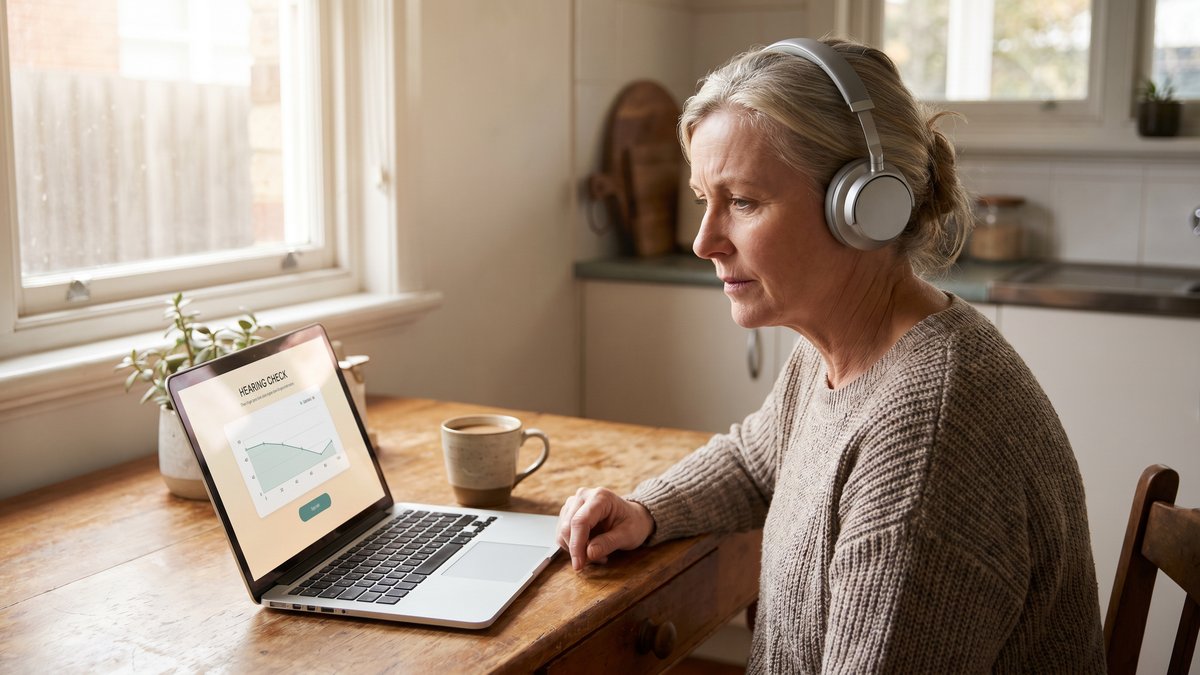
Online hearing tests have become increasingly popular as a convenient first step in understanding your hearing health. These digital screening tools use your computer, smartphone, or tablet to present a series of tones and sounds, measuring your ability to detect them. Within minutes, you receive results that may indicate whether you should seek a professional hearing assessment.
Here is the crucial thing to understand from the outset: online hearing tests are screening tools, not diagnostic assessments. Think of them as similar to checking your blood pressure at home versus having a full cardiovascular assessment at a medical clinic. They can flag that something may be worth investigating — but they cannot tell you what is actually happening with your hearing, or why.
This article explains how online hearing tests work, what they can and cannot do, when a professional assessment is the appropriate next step, and what Sunshine Coast residents can expect from that process.
How online hearing tests work
Online hearing tests use your device's speakers or headphones to present a series of sounds at different frequencies and volumes. The basic process typically follows these steps.
Most tests begin by asking you to find a quiet space and use headphones for more accurate results, sometimes with calibration steps to ensure your device volume is set correctly. This preliminary setup matters, because background noise or inconsistent volume levels can significantly affect your results.
The test then presents pure tones at various frequencies — typically ranging from low-pitched sounds like a bass guitar to high-pitched sounds like a bird chirping. You indicate when you can hear each tone by clicking a button or tapping your screen. The frequencies tested generally include those most important for understanding speech, typically between 500 Hz and 8,000 Hz.
Some more advanced online tests include a speech recognition component, presenting words or sentences with varying levels of background noise and asking you to identify what was said. After completing the test, you receive immediate feedback — often displayed as a basic pass/fail indicator, a percentage score, or a simplified chart — along with recommendations about whether professional assessment is advisable.
The entire process usually takes between five and fifteen minutes.
What online tests can and cannot do
What they can do
Online hearing tests can detect potential hearing changes that warrant further investigation, provide a general indication of your hearing sensitivity across different frequencies, offer a convenient way to monitor changes over time, and help you decide whether to schedule a professional hearing assessment.
Significant limitations
Environmental factors are a major variable. Online tests cannot control your testing environment. Background noise, room acoustics, and even the quality of your headphones can affect results. Professional hearing assessments take place in soundproof booths that eliminate these variables.
Equipment variability also matters. Computer speakers, smartphone speakers, and consumer-grade headphones vary widely in their frequency response and calibration. Professional audiological equipment is calibrated regularly to medical device standards.
Incomplete testing is perhaps the most significant limitation. Online tests typically assess only your hearing sensitivity to pure tones. A comprehensive professional assessment includes speech discrimination testing, tympanometry (middle ear function), acoustic reflex testing, otoscopic examination, bone conduction testing, real ear measurements, and a full medical history review.
No physical examination is possible remotely. Conditions like earwax impaction, foreign objects, or ear infections can significantly affect hearing but will not be detected by an online test.
Cannot identify causes. Online tests cannot determine why you might have hearing changes. The cause — whether earwax buildup, an ear infection, age-related hearing loss, noise exposure, or another factor — shapes what happens next, and only a qualified professional can make that determination.
When online hearing tests are useful
Despite their limitations, online hearing tests serve several valuable purposes.
Initial awareness check. If you are curious about your hearing but not yet concerned enough to book a professional appointment, an online test provides a low-pressure way to check in. Many people discover hearing changes gradually and may not realise they are experiencing difficulty until a screening tool highlights it.
Monitoring between appointments. If you have had a professional hearing assessment and do not currently need hearing aids, taking the same online test every six months can help you notice changes that warrant a follow-up professional assessment.
Overcoming hesitation. Hearing Australia reports that, on average, people wait seven to ten years between first noticing hearing changes and seeking professional help. Online hearing tests can help overcome this hesitation by providing objective feedback that encourages people to take action.
Family conversations. If you are concerned about a family member's hearing but they are reluctant to discuss it, an online hearing test can provide a gentle, non-confrontational way to open the conversation. Many people find objective results easier to accept than subjective observations from those around them.
When you need a professional hearing assessment
Online hearing tests should prompt you to seek professional care in a number of situations.
Your online test suggests hearing changes. If an online hearing test indicates you may have hearing changes, this is the time to book a comprehensive assessment with a qualified hearing care professional. Professional testing will provide accurate, detailed information across all frequencies and help identify any underlying causes.
You are experiencing symptoms in daily life. Regardless of online test results, schedule a professional hearing assessment if you frequently ask people to repeat themselves, struggle to follow conversations in background noise, find it difficult to hear on the telephone, need to increase television or radio volume beyond comfortable levels for others, experience ringing or buzzing in your ears (tinnitus), feel like people are mumbling, or avoid social situations because conversation is difficult.
You have sudden hearing changes. Sudden hearing loss — even in one ear — requires urgent medical attention. This is not appropriate for online testing. Contact your GP or an ear, nose, and throat specialist immediately if you experience sudden hearing changes, as prompt treatment within the first 72 hours can be important for recovery outcomes.
You have ear pain or discharge. These symptoms indicate possible infection or other medical conditions requiring professional medical evaluation. Online hearing tests cannot assess or diagnose medical conditions affecting the ear.
You are exposed to loud noise. If your work or hobbies involve regular exposure to loud noise — construction sites, manufacturing, live music, power tools, firearms, or motorsports — you should have regular professional hearing assessments regardless of online test results.
You are over 60. Age-related hearing changes are common, affecting about one in three Australians over 65. Regular professional hearing assessments every one to two years are generally recommended, even if you have not noticed significant changes.
**You are being reviewed by a medical professional for ongoing health management.** In these situations, professional hearing monitoring may be advisable as part of your overall care — discuss with your treating healthcare provider.
What to do after taking an online hearing test
Your next steps depend on your results and circumstances.
If results suggest no hearing loss: Consider retaking the test in six to twelve months, particularly if you are over 50 or have risk factors for hearing loss. Continue protecting your hearing from loud noise exposure, and remain aware of any changes in how you hear daily conversations, phone calls, or television.
If results suggest possible hearing changes: Schedule a comprehensive hearing assessment with a qualified professional. This is particularly important if the results align with difficulties you have been experiencing in daily life. Early action generally means more options are available.
If you are on the Sunshine Coast: Local hearing care clinics offer comprehensive hearing assessments across the region, from Caloundra to Noosa. Some clinics in the region offer no-cost initial hearing screenings — contact providers directly to confirm current availability and conditions. If you are eligible for the Hearing Services Program (pensioners, veterans, and others meeting criteria), your assessment and devices may be fully or partially subsidised.
Sunshine Coast residents have access to experienced hearing care professionals equipped with calibrated diagnostic equipment and soundproof testing booths, ensuring accurate results that form the basis for personalised hearing care.
Questions to ask when booking a professional assessment
- Is the assessment comprehensive, including speech testing and middle ear evaluation?
- What are the practitioner's qualifications? (Look for a Master's degree in Audiology or accreditation as a hearing aid audiometrist.)
- What are the fees? (Fees vary between providers; some may offer a complimentary initial screening — confirm when booking.)
- How long does the appointment take? (Usually 60 to 90 minutes for a comprehensive assessment.)
- Will you receive a copy of your results?
- If hearing support is recommended, what are the options and costs?
- What government funding programmes does the clinic work with?
If hearing support is recommended
A qualified professional will explain your options based on your specific hearing profile, lifestyle needs, and budget. Modern hearing technology has advanced significantly, with options ranging from basic amplification to sophisticated devices with Bluetooth connectivity, rechargeable batteries, and automatic environment adjustment.
If cost is a concern, ask about Hearing Services Program eligibility, payment plans, different technology levels and their respective costs, trial periods, and what is included in the price — batteries or charging accessories, follow-up appointments, warranty, and loss and damage insurance.
Professional hearing care is an ongoing relationship. Your hearing care professional provides initial fitting, adjustment appointments, ongoing maintenance, repairs, and advice as your hearing needs change over time.
Take the next step
If anything in this guide reflects your own situation, a comprehensive hearing assessment is the most reliable next step. At Hearingcare on the Sunshine Coast, Linda Whittaker — a Qualified Audiometrist with over 20 years of experience and ACAud accreditation — provides unhurried, individualised hearing care in a supportive environment.
We see clients from Caloundra, Maroochydore, Mooloolaba, Buderim, Noosa and across the wider Sunshine Coast region. Eligible clients may access fully subsidised hearing services (eligibility criteria apply) through the Australian Government's Hearing Services Program.
Individual results vary. Professional hearing assessment is required to determine the most appropriate management approach for your specific situation.

Frequently Asked Questions
Online hearing tests can provide a general indication of your hearing sensitivity, but they are screening tools rather than diagnostic assessments. Individual results vary based on factors including your testing environment, device quality, and how well you understand the instructions. Professional hearing assessments conducted in controlled conditions with calibrated equipment provide accurate, comprehensive results. If an online test suggests hearing changes, a professional assessment is recommended for accurate evaluation.
If you are over 50 or have risk factors for hearing loss (such as noise exposure or family history), taking an online hearing test every 6 to 12 months may help you notice changes that warrant professional evaluation. However, online tests should not replace regular professional hearing assessments, particularly if you are in a higher-risk category. Australian guidelines generally recommend professional hearing checks every one to two years for adults over 60.
An online hearing test is a brief screening tool that checks your hearing sensitivity to some tones using your personal device at home. A professional hearing assessment is a comprehensive evaluation conducted in a soundproof booth using calibrated medical equipment. Professional assessments include pure tone audiometry across all frequencies, speech testing, middle ear function tests, physical examination of your ears, medical history review, and personalised recommendations. They can also identify the cause of hearing changes and rule out medical conditions requiring treatment.
Most online hearing tests are free to use. However, some online tests may collect your contact information for marketing purposes or to encourage you to book a service. Read the privacy policy before providing personal details. Eligible individuals may access subsidised assessments through the Hearing Services Program, but confirm fees and conditions directly with the provider when booking. Disclaimer: This article is general information only and does not constitute medical, audiological, or clinical advice. Individual hearing needs vary. Please book a consultation with a qualified hearing care professional for personalised advice.
This article is for educational purposes only. Individual results may vary. Professional hearing assessment is recommended for personalised advice.
Book Your Hearing Assessment