


Why Does Real Ear Measurement Matter for Hearing Aids
Introduction
When you invest in hearing aids, you expect them to work properly. But here's something most people don't know: even the most advanced hearing aids won't perform as designed if they're not precisely fitted to your unique ears and hearing loss.
That's where real ear measurement (REM) comes in.
Real ear measurement is the gold standard for verifying that hearing aids are delivering the right amount of sound exactly where you need it. It's the difference between hearing aids that are "close enough" and hearing aids that are professionally calibrated to your individual needs.
In this article, we'll explain what real ear measurement is, how it works, why it matters for your hearing success, and what questions you should ask your hearing care professional about this essential verification process.
In This Article
- What Is Real Ear Measurement?
- How REM Works: The Science Behind the Measurement
- Why REM Matters: The Evidence for Better Outcomes
- The REM Process: What to Expect Step by Step
- REM vs Programming Without Verification: Understanding the Difference
- Questions to Ask Your Hearing Care Professional About REM
What Is Real Ear Measurement?
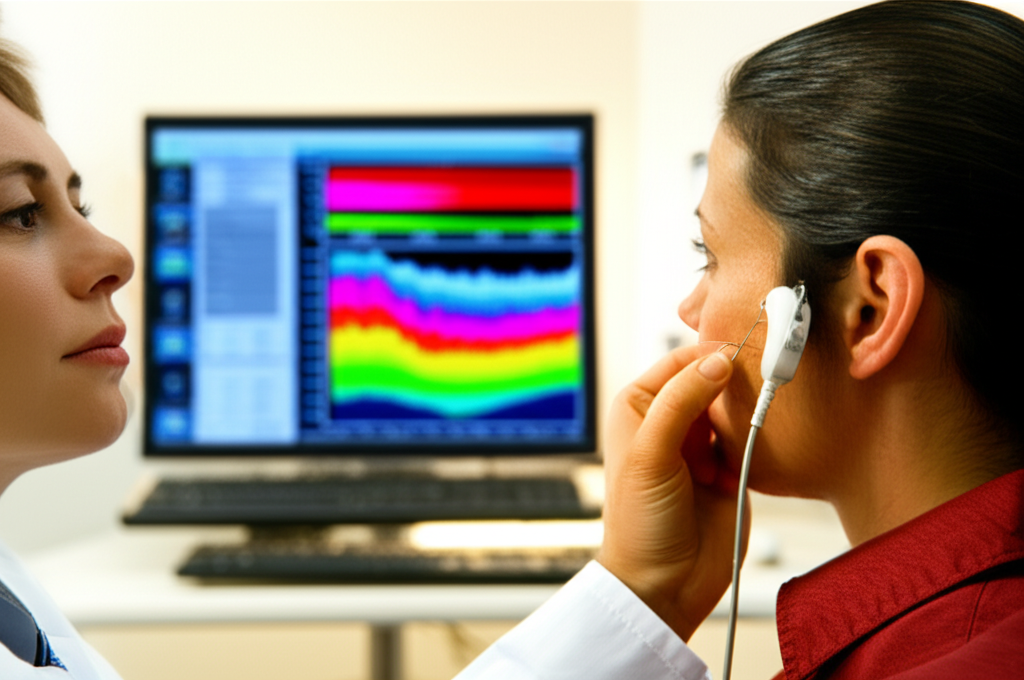
Real ear measurement (REM)—also called probe microphone measurement—is a verification procedure that measures the actual sound output of hearing aids inside your ear canal.
Here's the key point: your ear canal is unique. Its size, shape, and acoustics affect how sound behaves once it enters your ear. Two people wearing identical hearing aids programmed the same way will experience different sound levels because of these individual differences.
REM accounts for this by measuring what's actually happening inside your ear canal, not what a computer predicts should happen.
The Three Components of REM
Real ear measurement involves three key elements:
1. Probe microphone – A thin, flexible tube with a tiny microphone at the tip that's placed in your ear canal alongside your hearing aid
2. Reference microphone – A second microphone positioned near your ear to measure the sound coming from the speaker
3. Verification software – Computer programs that compare the measured sound against evidence-based prescription targets
During the measurement, your hearing care professional plays calibrated sounds through speakers while the probe microphone measures exactly how much sound is reaching your eardrum. This data is compared against prescription targets designed to provide optimal audibility based on your specific hearing loss.
How REM Works: The Science Behind the Measurement
Understanding how real ear measurement works helps you appreciate why it's so important for hearing aid success.
Step 1: Measuring Your Ear Canal Acoustics
Before inserting your hearing aid, your hearing care professional measures what's called your "real ear unaided response" (REUR). This baseline measurement shows how your ear canal naturally amplifies sound without any hearing aid present.
Your ear canal acts like a tiny resonating chamber, naturally boosting some frequencies (typically around 2,700-3,000 Hz) by about 10-15 decibels. This natural resonance is different for everyone based on ear canal size and shape.
Step 2: Calculating Prescription Targets
Based on your hearing test results (audiogram), verification software calculates prescription targets using evidence-based formulas like NAL-NL2 (National Acoustic Laboratories) or DSL (Desired Sensation Level).
These prescriptions specify exactly how much amplification you need at each frequency to restore audibility while maintaining comfortable listening levels. The targets account for your degree of hearing loss, your ear canal acoustics, and the type of sounds you need to hear.
Step 3: Measuring Hearing Aid Output
With your hearing aid inserted and the probe microphone in place, your hearing care professional measures the "real ear aided response" (REAR). This shows the actual sound level delivered by your hearing aid at various frequencies.
The verification software displays your measured response alongside the prescription targets, making it easy to see whether your hearing aids are providing too much amplification, too little, or just right.
Step 4: Fine-Tuning for Accuracy
If the measurements show that your hearing aids aren't meeting targets, your hearing care professional makes precise adjustments to the programming. This process is repeated until the measured output matches the prescription targets across all frequencies.
This verification process typically uses three different input levels:
- Soft sounds (50-55 dB SPL) – Ensures you can hear quiet speech and environmental sounds
- Average sounds (65 dB SPL) – Verifies comfortable amplification for normal conversation
- Loud sounds (80 dB SPL) – Confirms that loud sounds remain comfortable and don't cause discomfort
Why REM Matters: The Evidence for Better Outcomes
Real ear measurement isn't just "nice to have"—it's an essential quality assurance step that directly impacts your hearing aid success. Here's why it matters.
1. Manufacturer Programming Is Generic
When hearing aids are programmed using manufacturer software alone, they rely on average ear canal measurements. But research shows that individual ear canals can vary significantly from these averages.
A study published in The Hearing Journal found that relying on manufacturer first-fit programming without REM verification resulted in hearing aids that missed prescription targets by an average of 10-15 dB at certain frequencies. That's a significant difference that affects your ability to understand speech clearly.
2. REM Improves Speech Understanding
Multiple studies have demonstrated that hearing aids verified with real ear measurement provide better speech understanding compared to hearing aids fitted without verification.
One landmark study found that hearing aid users whose devices were verified with REM scored 12-15% higher on speech understanding tests compared to those fitted without REM. For real-world listening, this translates to:
- Better clarity in conversations, especially in noisy environments
- Improved ability to hear soft consonant sounds (s, f, th, sh)
- More natural sound quality without over-amplification
- Reduced listening effort throughout the day
3. Professional Guidelines Recommend REM
Leading audiology organisations worldwide recognise REM as the gold standard for hearing aid fitting:
- Audiology Australia – Recommends REM as best practice for all hearing aid fittings
- American Academy of Audiology – Guidelines state that probe microphone measurements should be conducted as part of the hearing aid fitting and verification process
- British Society of Audiology – REM is included in quality standards for hearing aid services
Despite these recommendations, research suggests that only 30-40% of hearing care professionals routinely use real ear measurement in Australia. This means many hearing aid users may not be receiving the full benefit of their devices.
4. REM Prevents Common Fitting Problems
Real ear measurement helps hearing care professionals identify and correct common fitting issues:
- Under-amplification – Hearing aids not providing enough volume, especially for soft sounds
- Over-amplification – Too much amplification causing discomfort or sound quality issues
- Frequency-specific problems – Missing targets at specific frequencies critical for speech understanding
- Occlusion effect – The hollow or boomy sound of your own voice when ear canals are blocked
By measuring objectively rather than relying solely on subjective feedback, REM catches problems that you might not notice immediately but that affect long-term satisfaction and benefit.
The REM Process: What to Expect Step by Step
If you're wondering what happens during a real ear measurement appointment, here's what you can expect.
Before the Measurement (5 minutes)
Your hearing care professional will:
- Explain the REM process and answer any questions
- Inspect your ear canals to ensure they're clear of wax (earwax can affect measurements)
- Check that your hearing aids are clean and functioning properly
- Set up the REM equipment, including positioning the reference microphone
During the Measurement (15-20 minutes per ear)
For each ear, the hearing care professional will:
1. Insert the probe tube – A thin, soft tube is gently placed in your ear canal, positioned about 5mm from your eardrum (you'll feel slight contact but it shouldn't be uncomfortable)
2. Measure your unaided response – Calibrated sounds are played through a speaker while the probe microphone measures your natural ear canal response
3. Insert your hearing aid – Your hearing aid is carefully positioned with the probe tube alongside it
4. Run verification measurements – Speech-like sounds at soft, average, and loud levels are played while the system measures the hearing aid output
5. Compare to targets – The hearing care professional reviews the measurements against prescription targets on the computer screen
6. Adjust and re-verify – If needed, adjustments are made to the hearing aid programming and measurements are repeated
After the Measurement (5-10 minutes)
Once verification is complete, your hearing care professional will:
- Show you the measurement results and explain how your hearing aids are performing
- Discuss any adjustments that were made
- Answer questions about sound quality or specific listening situations
- Provide recommendations for follow-up care
The entire process typically takes 30-45 minutes for both ears and is completely painless. Most people find it interesting to see the visual display of how their hearing aids are working.
REM vs Programming Without Verification: Understanding the Difference
To understand the value of real ear measurement, it helps to compare it to hearing aid fitting without verification.
Programming Without REM (First-Fit Approach)
When hearing aids are programmed without real ear measurement, the process typically involves:
- Entering your hearing test results into manufacturer software
- Using default or "first-fit" programming based on average ear canal measurements
- Relying on your subjective feedback about sound quality and volume
- Making adjustments based on trial and error
Limitations of this approach:
- Assumes your ear canal matches the average (which it may not)
- Doesn't account for individual acoustic differences
- Relies heavily on subjective feedback, which can be unreliable initially
- May take multiple follow-up visits to achieve optimal settings
- Some fitting issues may never be identified or corrected
Programming With REM (Evidence-Based Verification)
When real ear measurement is used, the process includes:
- Objective measurement of sound output in your actual ear canal
- Verification against evidence-based prescription targets
- Immediate identification of under-amplification or over-amplification
- Precise adjustments based on measured data, not guesswork
- Documentation that your hearing aids are meeting professional standards
Benefits of this approach:
- Higher likelihood of meeting prescription targets from the initial fitting
- Better speech understanding and sound quality
- Fewer follow-up visits for adjustments
- Greater confidence that hearing aids are performing as designed
- Objective documentation for quality assurance
Research consistently shows that hearing aids verified with REM provide better outcomes, higher satisfaction rates, and improved speech understanding compared to devices fitted without verification.
Questions to Ask Your Hearing Care Professional About REM
If you're considering hearing aids or currently wear them, here are important questions to ask your hearing care provider about real ear measurement:
Before Getting Hearing Aids
1. "Do you perform real ear measurement as part of your hearing aid fitting process?"
- This establishes whether REM is standard practice at the clinic
2. "Can you show me the REM equipment you use?"
- Demonstrates that the clinic has the proper tools and is willing to be transparent
3. "Will I be able to see my real ear measurement results?"
- Many people find it helpful to see visual confirmation that their hearing aids are working properly
4. "How much time is allocated for the REM verification appointment?"
- Proper REM verification requires adequate time (typically 30-45 minutes)
If You Already Wear Hearing Aids
5. "Were my current hearing aids verified using real ear measurement?"
- Important to know if verification was part of your original fitting
6. "Can we schedule an REM verification appointment for my existing hearing aids?"
- Even if REM wasn't done initially, it can still be performed to optimise your current devices
7. "How often should REM verification be repeated?"
- Best practice suggests annual verification or whenever significant adjustments are made
Understanding the Results
8. "Can you explain what my REM results mean?"
- Request a clear explanation of how your hearing aids performed against targets
9. "Are there any frequencies where my hearing aids aren't meeting targets?"
- Understanding specific gaps helps identify potential issues with speech clarity
10. "What adjustments did you make based on the REM measurements?"
- Knowing what changed helps you understand the before-and-after difference
Don't hesitate to ask these questions. Professional hearing care professionals expect informed questions and welcome the opportunity to explain their verification processes.
Key Takeaways
- Ensures accuracy – Measures actual sound output in your unique ear canal, not manufacturer estimates
- Improves outcomes – Research consistently shows better speech understanding with REM-verified hearing aids
- Saves time – Reduces the need for multiple follow-up appointments for adjustments
- Provides confidence – Offers objective proof that your hearing aids are working as designed
- Follows professional guidelines – Recommended by leading audiology organisations worldwide
Taking the Next Step: Evidence-Based Hearingcare on the Sunshine Coast
Real ear measurement is one of many quality indicators that distinguish professional, evidence-based hearing care from basic hearing aid dispensing.
At Hearingcare Australia on the Sunshine Coast, Linda Whittaker and our experienced audiology team use real ear measurement as standard practice for all hearing aid fittings and follow-up appointments. We believe you deserve objective verification that your hearing aids are working exactly as they should.
Whether you're considering hearing aids for the first time or seeking a second opinion on existing devices, we're here to provide thorough, professional hearing care backed by best-practice verification.
Ready to experience the difference that proper hearing aid verification makes?
Contact Hearingcare Australia to schedule a comprehensive hearing assessment. We'll take the time to explain every step of the process, including real ear measurement, so you feel confident in your hearing journey.
Hearingcare Australia – Sunshine Coast
Linda Whittaker, Clinical Hearing Care Professional
📞 Book your appointment today

Frequently Asked Questions
A hearing test (audiogram) measures your hearing—it identifies the softest sounds you can hear at different frequencies. Real ear measurement, on the other hand, measures your hearing aid's performance—it verifies that your hearing aids are delivering the right amount of amplification based on your hearing loss. Think of the hearing test as the diagnosis and REM as quality assurance for the treatment.
Unfortunately, no. While professional guidelines recommend REM as best practice, research suggests only 30-40% of hearing care professionals routinely use it in Australia. Common reasons include time constraints, lack of equipment, or reliance on manufacturer programming alone. When choosing a hearing care professional, it's worth asking specifically about REM verification.
Yes. Real ear measurement can be performed on hearing aids you currently wear, even if they were originally fitted elsewhere. In fact, if you're experiencing difficulties with speech clarity, comfort, or sound quality, requesting an REM verification appointment is a good troubleshooting step. The measurement can identify whether your hearing aids are meeting prescription targets or need adjustment. ---
This article is for educational purposes only. Individual results may vary. Professional hearing assessment is recommended for personalised advice.
Book Your Hearing Assessment