


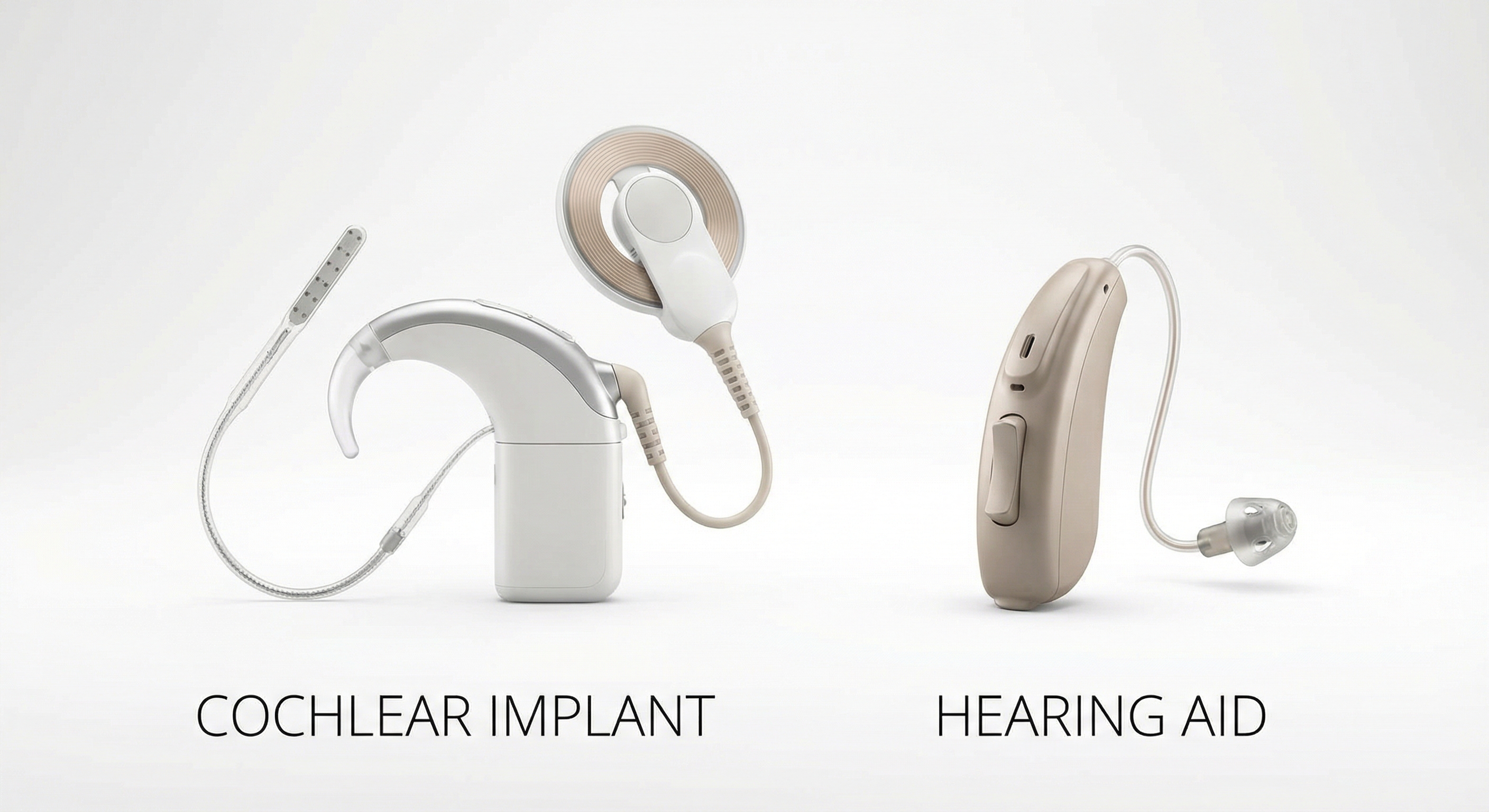
Should You Get a Cochlear Implant or Hearing Aid
How Hearing Aids Work
Hearing aids are electronic devices worn in or behind the ear that amplify sound to make it easier for people with hearing loss to hear conversations, music, and environmental sounds.
The Basic Technology
Modern hearing aids work through three main components:
1. Microphone – Picks up sound from the environment
2. Amplifier and Processor – Increases the volume of specific sound frequencies based on your hearing loss pattern
3. Speaker (receiver) – Delivers the amplified sound into your ear canal
Advanced digital hearing aids can be programmed to amplify certain frequencies more than others, matching your unique hearing profile. They can also reduce background noise, suppress feedback, and adjust automatically to different listening environments.
Who Benefits from Hearing Aids
Hearing aids are generally suitable for people with:
- Mild to moderately severe hearing loss
- Some residual hearing ability across different frequencies
- Functioning hair cells in the inner ear (cochlea)
- Clear speech understanding when sound is amplified sufficiently
Most Australians with hearing loss—estimated at around 1 in 6 people—find that hearing aids provide meaningful benefit for everyday communication and quality of life.
Types of Hearing Aids
Common styles include:
- Behind-the-ear (BTE)
- Receiver-in-canal (RIC)
- In-the-ear (ITE)
- In-the-canal (ITC)
- Completely-in-canal (CIC)
Your hearing care professional can help determine which style suits your hearing loss, lifestyle, dexterity, and aesthetic preferences.
In This Article
How Cochlear Implants Work
Unlike hearing aids, which amplify sound, cochlear implants work by bypassing damaged portions of the inner ear and directly stimulating the auditory nerve.
The Technology Behind Cochlear Implants
A cochlear implant system has two main parts:
External Components (worn outside the body):
1. Microphone – Captures sound from the environment
2. Sound processor – Converts sound into digital signals
3. Transmitter coil – Sends signals through the skin to the internal device
Internal Components (surgically implanted):
1. Receiver – Receives signals from the external transmitter
2. Electrode array – A thin wire with multiple electrodes inserted into the cochlea
3. Electrodes – Directly stimulate different regions of the auditory nerve
When sound enters the microphone, the processor analyses it and converts it into electrical signals. These signals are sent to the internal receiver, which passes them to the electrode array. The electrodes stimulate the auditory nerve fibres, which send impulses to the brain, where they're interpreted as sound.
A Different Way of Hearing
It's important to understand that cochlear implants don't restore "normal" hearing. Instead, they provide a representation of sound that the brain learns to interpret. Many cochlear implant recipients describe the initial sound quality as robotic or electronic, but with time and auditory rehabilitation, the brain adapts and speech understanding typically improves significantly.
Who May Be Considered for Cochlear Implants
Cochlear implants may be considered for individuals with:
- Severe to profound sensorineural hearing loss in both ears
- Limited benefit from well-fitted hearing aids after an appropriate trial period
- No medical contraindications to surgery
- Realistic expectations about outcomes
- Commitment to rehabilitation and follow-up care
Both children and adults can be candidates, though the assessment process and expected outcomes differ between age groups.
Key Differences: Comparison Table
| Feature | Hearing Aids | Cochlear Implants |
|---|---|---|
| How they work | Amplify sound waves | Directly stimulate auditory nerve |
| Degree of hearing loss | Mild to severe | Severe to profound |
| Procedure | Non-surgical (fitted and programmed) | Requires surgery under general anaesthesia |
| Components | Entirely external | External processor + internal implant |
| Adjustment period | Days to weeks | Months to years with rehabilitation |
| Reversible | Yes (can be removed anytime) | No (inner ear structures are permanently altered) |
| Suitable for | People who benefit from amplification | People who gain minimal benefit from hearing aids |
| Daily maintenance | Battery changes, cleaning | Battery/charging, coil attachment, processor care |
| Lifespan | 3-7 years typically | Internal device: 20+ years; External processor: 5-10 years |
| MRI compatibility | Generally compatible | Requires special precautions or magnet removal |
| Water resistance | Many models water-resistant | External processor must be removed for swimming |
| Funding options (Australia) | HSP, NDIS, DVA, private health insurance | Public hospital (free for eligible Australians), private insurance |
Who Is a Candidate for Each?
Hearing Aid Candidacy
You may be a candidate for hearing aids if you:
- Have mild to moderately severe hearing loss
- Can understand speech reasonably well when sounds are made louder
- Have some hearing ability in the frequency ranges important for speech
- Experience difficulty in certain listening situations (restaurants, group conversations)
- Notice you're turning up the TV or asking people to repeat themselves
There's no strict "cutoff" for when hearing aids are appropriate—it depends on your individual hearing profile, communication needs, and lifestyle. A comprehensive hearing assessment with a hearing care professional can help determine if hearing aids are suitable for you.
Cochlear Implant Candidacy
Cochlear implant candidacy is more complex and typically requires assessment by a specialised cochlear implant team. General criteria include:
Adults:
- Severe to profound sensorineural hearing loss in both ears
- Word recognition score below 50% in the ear to be implanted (and below 60% in the better ear) when using optimally fitted hearing aids
- Limited benefit from hearing aids in everyday listening situations
- No medical contraindications
- Motivation to participate in rehabilitation
Children:
- Profound bilateral sensorineural hearing loss (or severe loss with limited hearing aid benefit)
- Age typically 12 months or older, though some centres may consider younger children
- Family commitment to auditory rehabilitation and follow-up
- No developmental or medical contraindications
Important Note: Candidacy criteria have expanded in recent years. Some individuals with residual low-frequency hearing may now be candidates for hybrid devices or "electroacoustic stimulation." Others with single-sided deafness may qualify for a cochlear implant in one ear.
The Cochlear Implant Process
Understanding what's involved in receiving a cochlear implant can help you make an informed decision.
Step 1: Initial Assessment
The process typically begins with:
- Comprehensive hearing tests (audiometry)
- Hearing aid trial and assessment (if not already completed)
- Medical history review
- Discussion of expectations and lifestyle needs
If initial tests suggest you might be a candidate, you'll be referred to a cochlear implant clinic.
Step 2: Cochlear Implant Evaluation
At a specialised cochlear implant centre, you'll undergo:
- Detailed hearing tests with and without hearing aids
- Speech perception testing in quiet and noisy environments
- Medical examination by an ENT surgeon
- CT or MRI scans to assess inner ear anatomy
- Psychological assessment (to evaluate expectations and support)
- Discussions with the implant team (hearing care professionals, surgeons, speech pathologists)
This multidisciplinary assessment typically takes several appointments over weeks or months.
Step 3: Decision and Surgery
If you're deemed a suitable candidate and choose to proceed:
- You'll select a cochlear implant device (several brands are available in Australia)
- Surgery is scheduled (usually day surgery or overnight stay)
- The procedure takes 2-4 hours under general anaesthesia
- Recovery time is typically 1-2 weeks before the wound heals
The surgeon creates a small incision behind the ear, places the internal receiver under the skin, and carefully inserts the electrode array into the cochlea.
Step 4: Activation and Programming
About 2-4 weeks after surgery (once healing is complete):
- The external sound processor is fitted
- The device is "switched on" for the first time
- The hearing care professional programs the processor based on your responses
- You begin hearing through the cochlear implant
Many people describe this moment as emotional—sounds may seem strange, robotic, or overwhelming at first.
Step 5: Rehabilitation and Adjustment
This is arguably the most important phase:
- Regular appointments for processor adjustments (mapping)
- Auditory training exercises to help your brain interpret new signals
- Speech therapy (especially important for children)
- Gradual improvement in speech understanding over months to years
Success with a cochlear implant depends heavily on commitment to this rehabilitation process.
Life with a Cochlear Implant
Daily life with a cochlear implant differs from life with hearing aids in several ways.
Daily Maintenance
- Charging or battery changes: External processors require daily charging or regular battery replacement
- Coil attachment: The external transmitter coil must be positioned correctly over the internal receiver
- Moisture protection: External components must be removed before swimming or showering
- Cleaning: Regular cleaning of the processor and coil
What to Expect
Early Days (Weeks 1-3):
- Sounds may seem robotic, high-pitched, or overwhelming
- Understanding speech is often challenging
- Environmental sounds (traffic, footsteps, rustling) may be distracting
- Frequent mapping appointments for fine-tuning
First Few Months:
- Gradual improvement in sound quality as your brain adapts
- Speech understanding begins to improve, especially in quiet
- Music may still sound distorted
- Continued mapping and adjustments
6-12 Months and Beyond:
- Many recipients report significant improvement in speech understanding
- Some can use the telephone with reasonable success
- Music appreciation varies—some find it enjoyable, others find it remains challenging
- Most adapt well to everyday listening environments
Individual Results Vary: Some people adapt quickly and achieve excellent speech understanding within months, while others take longer. Factors influencing outcomes include duration of hearing loss before implantation, age, cognitive function, motivation, and quality of rehabilitation support.
Lifestyle Considerations
- MRI scans: May require special arrangements or temporary magnet removal
- Sports and physical activity: Most activities are fine, but contact sports require careful consideration
- Airport security: Metal detectors may trigger alarms—carry your implant identification card
- Electronic devices: Modern implants are robust, but strong magnetic fields should be avoided
- Driving and employment: Most recipients can drive and work without issues
Cost and Funding in Australia
Understanding the financial aspects is an important part of the decision-making process.
Hearing Aids
Costs:
- Prices vary significantly based on technology level, features, and brand
- Contact us for current pricing information
Funding Options:
- Hearing Services Program (HSP): Australian Government program providing subsidised hearing services for eligible pensioners, veterans, and other groups
- NDIS: May fund hearing aids for eligible participants
- DVA: Department of Veterans' Affairs covers hearing services for eligible veterans
- Private health insurance: Many extras policies provide rebates
- Self-funded: For those not eligible for government programs
Cochlear Implants
Costs:
- Surgery and device through the public hospital system: Generally no out-of-pocket cost for eligible Australians
- Private hospital pathway: Costs vary; private health insurance may cover part or all
Funding Options:
- Public Hospital System: Cochlear implant surgery and initial device are typically provided free of charge through public hospitals for Australian citizens and permanent residents who meet clinical criteria
- Private Health Insurance: Some policies cover private cochlear implant surgery and device costs
- NDIS: May fund cochlear implants and associated therapies for eligible participants
- DVA: Covers cochlear implants for eligible veterans
Ongoing Costs:
- Replacement processors (every 5-10 years)
- Batteries or charging accessories
- Warranty coverage options
- Travel to and from appointments
- Auditory rehabilitation sessions
Important: Eligibility criteria and funding arrangements can change. Contact your state cochlear implant clinic or hearing services provider for current information.
Key Takeaways
- Hearing aids amplify sound for people with mild to severe hearing loss, while cochlear implants bypass damaged parts of the ear and directly stimulate the auditory nerve for those with severe to profound hearing loss
- Candidacy differs significantly: Hearing aids are suitable for those who benefit from amplification; cochlear implants are considered when hearing aids provide limited benefit
- Surgery is required for cochlear implants, making the decision permanent, whereas hearing aids are non-surgical and reversible
- Rehabilitation is crucial for cochlear implant success—outcomes depend heavily on commitment to auditory training and follow-up appointments
- Both devices require daily maintenance including charging/battery changes, cleaning, and regular professional adjustments
- Funding is available in Australia through public hospitals, HSP, NDIS, DVA, and private health insurance for eligible individuals
- Individual results vary for both hearing aids and cochlear implants—professional assessment is essential to determine the most appropriate option for your specific hearing loss and lifestyle needs
Your Next Steps
If you're wondering whether hearing aids or cochlear implants might be appropriate for you or a loved one, the first step is a comprehensive hearing assessment with a qualified hearing care professional.
At Hearingcare on the Sunshine Coast, we can provide hearing tests, hearing aid trials, and referrals to cochlear implant centres if appropriate. Queensland has several public hospital cochlear implant programs in Brisbane, as well as private options.
A professional hearing assessment takes approximately 60-90 minutes and provides a clear picture of your hearing ability, communication challenges, and available solutions. Contact us to arrange an appointment at your convenience.
Remember: Every person's hearing journey is unique. What works well for one individual may not be the best option for another. Professional guidance, combined with your personal preferences and lifestyle needs, will help you make the most informed decision.

Frequently Asked Questions
Music perception with cochlear implants varies significantly between individuals. While speech understanding often improves considerably, music can remain challenging because cochlear implants have limited ability to transmit the complex pitch and tonal information that makes music rich and enjoyable. Some recipients find they can appreciate music, especially with practice and training, while others find it less satisfying than before their hearing loss.
The internal implant device is designed to last a lifetime—many have been functioning for 20+ years. The external sound processor typically needs replacing every 5-10 years as technology advances or components wear out. Manufacturers often offer upgrade programs, and funding options may be available through NDIS or other schemes for processor replacements.
Yes, cochlear implants are considered safe for children and have been used in paediatric populations for over 30 years. Early implantation (typically from 12 months of age) in children born with profound hearing loss can support speech and language development during critical early years. The decision involves careful assessment by specialists.
Yes, if your hearing loss progresses to the point where hearing aids no longer provide adequate benefit, cochlear implants may become an appropriate option. Regular hearing assessments with your hearing care professional help monitor any changes. Many cochlear implant recipients are people who successfully used hearing aids for years before their hearing loss progressed. ---
This article is for educational purposes only. Individual results may vary. Professional hearing assessment is recommended for personalised advice.
Book Your Hearing Assessment