


What happens during a hearing test? Your assessment, step by step
In This Article
A full adult hearing test in Australia is painless, non-invasive and usually takes 60 to 90 minutes. It starts with a conversation about your hearing history, then a look in your ears, then a series of listening checks in a sound-treated booth. You leave with your results explained on the day — including whether any hearing loss is present, what type it is, and what your options are.
How long does a hearing test take?
Allow 60 to 90 minutes for a comprehensive adult hearing assessment. That includes the conversation about your hearing history, the tests themselves, and time to go through your results properly. A quick "hearing check" or screening — the kind offered in shopping centres — takes about 5 to 15 minutes, but it is an indicator only, not a diagnostic assessment. At Hearingcare in Caloundra, appointments are unhurried by design: the discussion of your results is treated as the most important part of the visit.
Do you need a referral for a hearing test in Australia?
No referral is needed to book a hearing test with an audiometrist or audiologist — you can simply call and book. A GP is the right first stop, though, if you have ear pain, discharge or sudden hearing loss. Eligible pensioners and DVA card holders may access subsidised testing through the Australian Government Hearing Services Program — eligibility criteria apply.
What tests are included in a full hearing assessment?
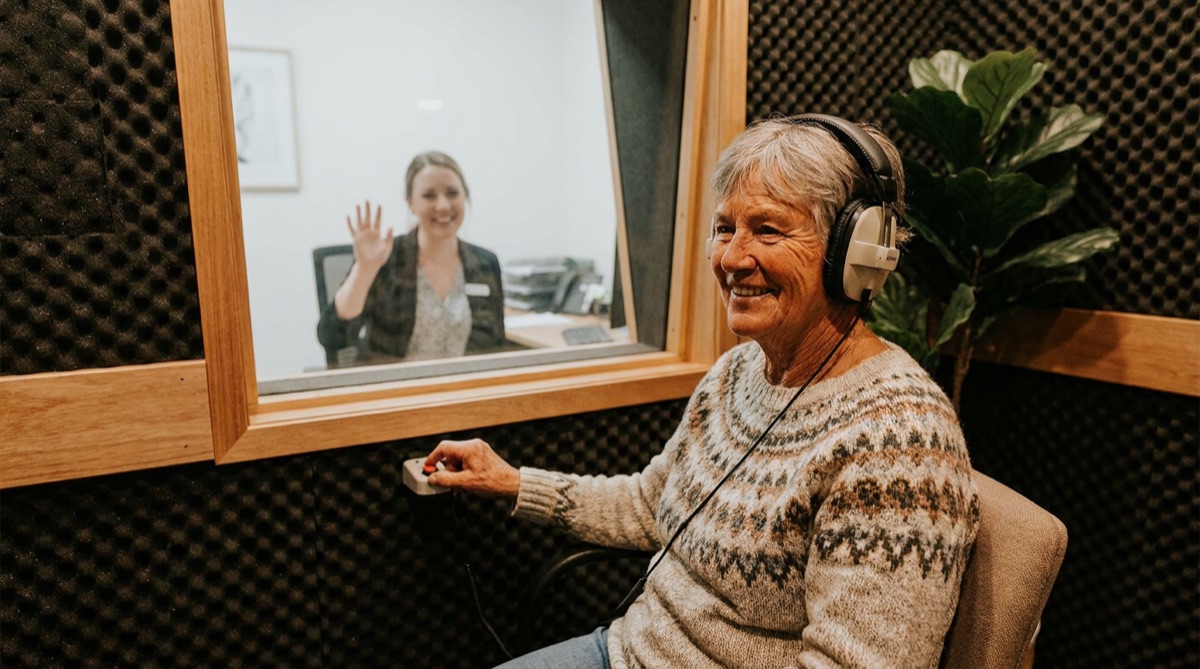
A comprehensive assessment typically includes four parts. First, a case history — where you notice difficulty, medical background, noise exposure. Second, otoscopy — the clinician looks in your ear canal and at your eardrum. Third, pure tone audiometry in a sound-treated booth: you wear headphones and respond to tones at different pitches and volumes, which builds your audiogram. Fourth, speech testing and, where indicated, tympanometry — a quick check of how your eardrum and middle ear are moving.
| Test | What it checks | What it feels like |
|---|---|---|
| Case history | Your hearing situations & health background | A conversation |
| Otoscopy | Ear canal & eardrum | A light and a gentle look — no discomfort |
| Pure tone audiometry | Softest sounds you hear, pitch by pitch | Pressing a button when you hear a tone |
| Speech testing | How clearly you hear words | Repeating words at different volumes |
| Tympanometry | Eardrum & middle ear movement | Brief pressure change, like a lift ride |
Does a hearing test hurt, and what should you bring?
Nothing in a hearing test hurts. The strangest sensation is tympanometry's brief pressure change, similar to what you feel in a lift or on descent in a plane. What to bring: your Pensioner Concession or DVA card if you have one, a list of your medications, and your glasses if you wear them. If English isn't your first language or you'd simply like support, bring a family member — a familiar voice is genuinely useful in speech testing discussions.
"People are often nervous before their first hearing test, and the most common thing I hear afterwards is that it was far easier than they expected," says Linda Whittaker, Qualified Audiometrist at Hearingcare in Caloundra.
Your results are plotted on an audiogram — a simple graph of your hearing, pitch by pitch — and explained in plain English before you leave. If you are ready to have your hearing checked, you can book a comprehensive adult hearing assessment at our Bulcock Street clinic in Caloundra, serving Golden Beach and the Sunshine Coast.
How do you read your audiogram results?
Your audiogram plots the softest sounds you can hear at each pitch, for each ear. Results within the normal range sit near the top of the graph; mild, moderate and severe hearing loss sit progressively lower. Your audiometrist walks through the graph with you on the day, in plain English — which sounds you hear well, which pitches show reduced sensitivity, and what that means in real conversations. You receive a copy of your results to keep, in Caloundra, Queensland or wherever you have your test.
The information on this page is general in nature, and hearing outcomes, results and experiences vary from person to person. It is not a substitute for professional advice about your individual hearing health. Eligibility criteria apply to government programs, such as the Hearing Services Program. For advice specific to you, book an appointment with our Qualified Audiometrist.
Last reviewed July 2026 by Linda Whittaker, Qualified Audiometrist.
Take the next step
If anything in this guide reflects your own situation, a comprehensive hearing assessment is the most reliable next step. At Hearing Care on the Sunshine Coast, Linda Whittaker — a Qualified Audiometrist with more than 20 years of clinical experience and ACAud membership — provides unhurried, individualised hearing care in a supportive environment.
We see clients from Caloundra, Maroochydore, Mooloolaba, Buderim, Noosa and across the wider Sunshine Coast region. Eligible clients may access fully subsidised hearing services (eligibility criteria apply) through the Australian Government's Hearing Services Program.
Individual results vary. Professional hearing assessment is required to determine the most appropriate management approach for your specific situation.

This article is for educational purposes only. Individual results may vary. Professional hearing assessment is recommended for personalised advice.
Book Your Hearing Assessment